Best Custom Packaging Partners for Growing Businesses
23 July 2026
Best Custom Packaging Partners for Growing Businesses
Why Packaging Has Become a Strategic Priority
Custom packaging has undergone a significant shift in how serious businesses view it. The global custom packaging market was valued at $48.17 billion in 2025 and is projected to reach $81 billion by 2034 — a trajectory driven not by novelty but by commercial necessity. 61% of brands plan to increase their packaging spend in 2026, with packaging increasingly viewed as a revenue driver rather than a cost centre. Custom packaging increases brand recognition by up to 40% compared to generic alternatives, and 30% of products are damaged in transit due to inadequate packaging — a statistic that translates directly into return costs, customer service overhead, and reputational damage.
For managers responsible for procurement, operations, or ecommerce, this means packaging decisions deserve more structured attention than they often receive. The wrong partner affects more than aesthetics. A bad call on materials, lead times, or minimum order quantities quietly erodes margins and creates operational friction that compounds as the business scales. The right partner, by contrast, delivers consistency, predictability, and the kind of unboxing experience that generates the repeat purchases and social endorsements that are increasingly difficult to buy through advertising alone.
This guide covers five custom packaging partners worth serious consideration for growing businesses, alongside a framework for evaluating any supplier against your specific operational stage and requirements.
The Real Challenge in Finding the Right Partner
The packaging market is crowded, and most suppliers present well on a website. The practical challenge is distinguishing companies with genuine manufacturing depth from those with polished marketing and inconsistent delivery. Print quality across production runs is harder to maintain than most suppliers acknowledge. A misprint batch isn’t just a quality problem — it’s a delay, a reorder cost, and a customer experience problem arriving simultaneously. Lead time claims often don’t account for peak demand periods or quality review cycles. And low minimum order quantities sometimes come with per-unit pricing that makes the economics unrealistic at the volumes a growing business actually needs.
Good procurement decision making and problem solving practice means evaluating suppliers against operational reality rather than marketing claims — checking third-party reviews for consistent themes, verifying certifications independently, and understanding exactly what the per-unit cost looks like at your actual order frequency before committing. The evaluation framework at the end of this guide covers the specific questions worth asking before any partnership decision.
Five Custom Packaging Partners Compared
Every option here was researched using publicly available information from official websites, review platforms, and customer case studies. Only companies with a documented track record in packaging manufacturing made the final list.
1. Arka — Best for ecommerce and DTC brands seeking sustainable custom packaging
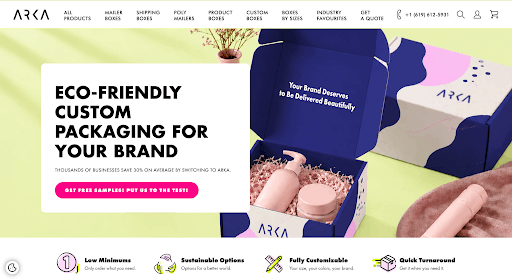
Arka is a San Francisco-based custom packaging company built specifically for ecommerce and direct-to-consumer brands. Their product range covers custom mailer boxes, shipping boxes, poly mailers, and retail boxes with full print customisation through a 3D Design Studio. Minimum orders start at single units, and their platform integrates with Shopify and BigCommerce — which means packaging management connects directly to where orders are being processed rather than sitting in a separate workflow.
What distinguishes Arka is their combination of low MOQs with sustainable materials and AI-driven inventory replenishment that reduces the reorder guesswork that growing brands deal with constantly. Customer reviews consistently highlight the founder-level involvement in problem-solving and the balance between affordability, eco-friendly materials, and print quality — a combination that comparable platforms struggle to deliver simultaneously.
Best for: Ecommerce and DTC brands that need sustainable packaging at low minimums without sacrificing quality or operational integration.
2. Packlane — Best for custom packaging design and manufacturing
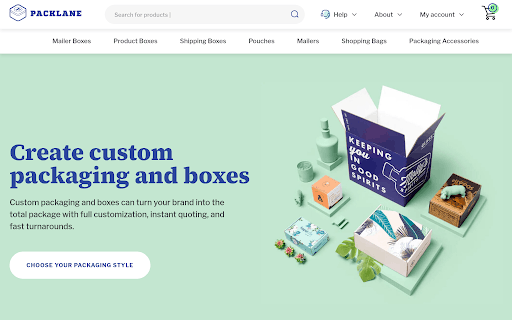
Packlane runs an online platform for custom packaging where brands design and order personalised mailer boxes, shipping boxes, and product boxes through a 3D design tool with real-time pricing. With over 25,000 brands served — including Everlane, L’Oreal, and Benefit Cosmetics — they have demonstrated capacity to handle both emerging and established brand requirements. Production turnaround runs 10 days or less, and their materials include recyclable substrates and soy-based inks.
Their real-time quote tool removes the back-and-forth that slows down procurement, which matters when teams are moving quickly. Customer reviews consistently describe the design platform as genuinely intuitive — not in a marketing-copy sense, but in the practical sense of not requiring design expertise or support calls to operate. Brands with complex order histories point to pricing predictability and lead time consistency as the primary reasons for returning.
Best for: Teams that need fast turnarounds with design flexibility and don’t want to manage a lengthy procurement process.
3. EcoEnclose — Best for sustainable ecommerce packaging
EcoEnclose is an environmentally responsible packaging manufacturer based in Louisville, Colorado, focused entirely on eco-friendly shipping supplies and retail packaging. Every product uses 100% post-consumer recycled content with zero virgin plastics. They hold Climate Neutral Certification and a B Corporation score of 94.3, placing them in the top 10% globally for environmental performance — a verified figure rather than a marketing claim, which matters significantly for brands operating under sustainability scrutiny.
With over 25,000 customers served and 47 million pounds of waste diverted from landfills, EcoEnclose backs their environmental commitments with documented outcomes. Customer reviews reflect a community of brands that genuinely care about those numbers, with long-term loyalty driven by the consistency between what EcoEnclose claims and what they actually deliver.
Best for: Brands with genuine environmental commitments that need verified, third-party-certified sustainable packaging.
4. Packola — Best for small businesses and entrepreneurs
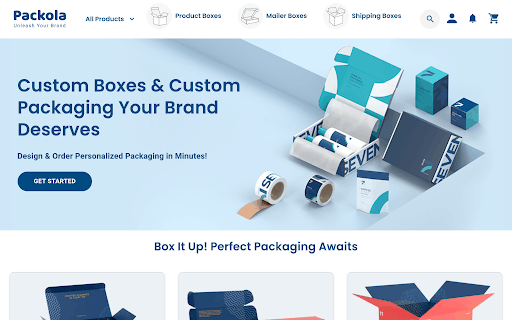
Packola is a custom packaging platform built with small businesses and entrepreneurs clearly in mind. They offer personalised product boxes, mailer boxes, shipping boxes, and custom labels with no minimum order requirements, a print-readiness inspection before every production run, and standard turnaround of 12 to 15 business days. Their online design tool requires no design experience, and production stays domestic — which keeps lead times more predictable than overseas sourcing.
Customer reviews highlight ease of navigation, customer service quality, and fair handling of quality issues as the consistent themes. The brand’s reputation is strongest with small to mid-sized businesses and emerging brands, which reflects where they have focused their operational design.
Best for: Founders and early-stage brands that need professional-grade custom packaging without MOQ commitments or design-skill requirements.
5. PakFactory — Best for complex custom packaging manufacturing
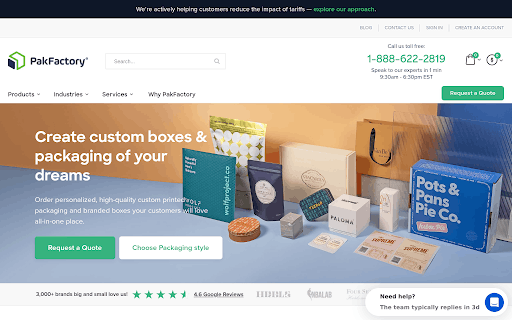
PakFactory is a full-service custom packaging company based in Markham, Ontario, covering folding cartons, corrugated boxes, POP displays, and labels. Their service model extends well beyond production to include packaging strategy, structural engineering, artwork design, cost analysis, and physical sampling — making them more of an end-to-end packaging partner than a print vendor. They operate across multiple facilities in North America and globally, serving industries from cosmetics and jewellery to food and beverage.
PakFactory addresses the gap that growing businesses encounter when packaging needs become too complex for a self-serve platform but not yet large enough to justify an in-house packaging team. Clients in specialised categories point to the structural engineering support as particularly valuable — having designers and engineers on the same team reduces defect rates and shortens approval cycles.
Best for: Growing businesses with complex packaging requirements that need strategic and structural support alongside production.
How to Evaluate Any Custom Packaging Partner
The right partner depends on matching your current operational stage against what each company genuinely delivers. A structured evaluation approach helps avoid the most common procurement mistakes in this category.
The questions that matter before you commit
Start with industry experience. Does the supplier have a documented history in your specific product category? A company specialising in cosmetics packaging will catch structural issues that a generalist might miss entirely.
Then assess operational fit. What is the actual minimum order quantity and per-unit cost at your realistic order frequency — not the lowest possible quantity, but the volumes you’ll actually be ordering? What is the turnaround time from order confirmation to delivery, and does that work within your fulfilment model? Can they accommodate design changes between orders without significant cost penalties?
Ask for performance data. Can the supplier provide defect rates, on-time delivery percentages, and prototype-to-approval cycle times? Partners who track and share these metrics are generally more reliable than those who can’t or won’t.
For regulated categories — food, medical, or hazardous materials — verify that the supplier understands the relevant packaging standards and material restrictions. General manufacturing experience doesn’t automatically transfer to regulated environments. The Knowledge Hub on managing projects and change covers procurement evaluation frameworks that apply directly here, particularly around defining requirements before comparing suppliers rather than letting the comparison drive the requirements.
The Management Dimension
Packaging procurement sits at the intersection of brand, operations, and customer experience — which means the decision affects more stakeholders than it initially appears. The unboxing experience that a customer photographs and shares online is shaped by decisions made months earlier in a supplier evaluation process. The return cost generated by inadequate protective packaging shows up in the P&L but originates in the specification stage. The environmental credentials that a retail partner or institutional buyer requests are only as credible as the certifications the packaging supplier can evidence.
61% of brands are planning to increase packaging spend in 2026, reflecting a broader recognition that packaging is a commercial lever rather than a commodity input. The brands that will see the greatest return from that investment are those that make the supplier selection decision as carefully as any other strategic procurement choice — evaluating against operational requirements, verifying claims independently, and choosing partners whose capacity to deliver matches the business’s trajectory rather than just its current size.
Good decision making and goal setting practice treats packaging procurement as a strategic decision with downstream consequences — not a purchasing detail to be resolved quickly and revisited only when something goes wrong.
Further Reading
- Fortune Business Insights: Custom Packaging Market Size, Share and Growth Analysis — Comprehensive market sizing and growth data for the custom packaging sector, including North American dominance, ecommerce drivers, and the forecast trajectory to 2034. Read the report
- ZEE Custom Boxes: Packaging Industry Statistics 2026 — A well-sourced collection of current packaging industry data including brand recognition impact, damage statistics, and the shift toward packaging as a revenue driver. Read the article
- IndexBox: Custom Packaging Boxes Market Forecast 2026–2035 — Strategic market analysis covering the structural transformation of custom packaging from supply chain input to brand asset, with particular attention to ecommerce drivers and sustainability mandates. Read the forecast
Header Image by Muhammad Naufal Subhiansyah from Pixabay
Disclaimer
The content on this site is provided for general information and educational purposes only. It reflects the author’s views and experience and is not intended as professional procurement, legal, or business advice. Supplier capabilities, pricing, and service terms change frequently — readers should verify current specifications directly with suppliers before making decisions. Inclusion of specific companies in this article does not constitute an endorsement. The Happy Manager and Apex Leadership Ltd accept no liability for decisions made on the basis of anything published here.
References
- Fortune Business Insights (2026). Custom Packaging Market Size, Share and Growth Analysis 2026–2034. https://www.fortunebusinessinsights.com/custom-packaging-market-107677
- ZEE Custom Boxes (2026). Packaging Industry Statistics 2026. (61% of brands increasing packaging spend; 40% brand recognition uplift; 30% transit damage rate.) https://zeecustomboxes.com/packaging-industry-statistics-2026/
- IndexBox (2026). Custom Packaging Boxes Market Growth to Accelerate by 2035 Driven by E-Commerce and Sustainability Mandates. https://www.indexbox.io/blog/custom-packaging-boxes-market-growth-to-accelerate-by-2035-driven-by-e-commerce-and-sustainability-mandates/
- Maximize Market Research (2026). Custom Packaging Market Size, Share and Forecast 2026–2032. ($6.63bn segment market value, 4.6% CAGR.) https://www.maximizemarketresearch.com/market-report/custom-packaging-market/206551/
Leadership Resources
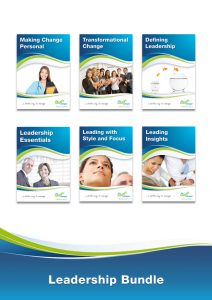 For more leadership resources look at our great-value guides. These include some excellent tools to help your personal development plan. The best-value approach is to buy our Leadership bundle, available from the store.
We’ve bundled together these five e-guides at half the normal price! Read the guides in this order, and use the tools in each, and you’ll be well on your way to achieving your personal development plan. (6 guides, 167 pages, 27 tools and 22 insights, for half price!)
- Leadership Essentials
- Defining Leadership
- Leading Insights
- Leading with Style and Focus
- Transformational Change
- Making Change Personal
Blog Content: Most blog pages on this site are from sponsored or guest contributors. Although we may receive payment for these, all posts are vetted to ensure they meet our editorial standards and offer value for our readers.
>> Return to the Leadership Knowledge Hub