Best Sustainable Mailers for E-Commerce Shipping (2026 Guide)
22 July 2026
Best Sustainable Mailers for E-Commerce Shipping (2026 Guide
Why Packaging Has Become a Strategic Management Decision
Sustainable mailers have moved from a brand differentiator to a commercial and regulatory necessity for ecommerce businesses in 2026. Products with ESG-related claims averaged 28% cumulative growth over a five-year period compared to 20% for products making no sustainability claims, according to a joint McKinsey and NielsenIQ study covering 600,000 SKUs across 44 categories. Meanwhile, the EU Packaging and Packaging Waste Regulation (PPWR) — which applies from August 2026 — mandates that all packaging placed on the EU market be fully recyclable by 2030 and restricts ecommerce packaging with more than 50% empty space. In the US, seven states have enacted Extended Producer Responsibility packaging laws with producer fees modulated by recyclability performance grades. The regulatory pressure is concrete rather than aspirational, and it’s arriving on a specific timeline.
For managers responsible for procurement, supply chain, or ecommerce operations, the packaging decision has therefore expanded well beyond aesthetics. Choosing the wrong mailer carries compliance risk, return costs when products are damaged in transit, and reputational exposure if sustainability claims don’t hold up under scrutiny. Greenwashing is now enforceable in both the UK and EU — the FCA’s anti-greenwashing rule and ESMA’s ESG disclosure requirements both create accountability for claims that aren’t backed by verifiable evidence. The packaging supplier you choose is now, in effect, part of your compliance infrastructure.
This guide covers five sustainable mailer suppliers that hold up on certifications, materials, and real-world ecommerce usability — and the framework for evaluating any supplier against your specific operational needs.
Why Getting This Right Is Harder Than It Looks
Choosing genuinely sustainable mailers is complicated by how consistently the term is misused. “Recyclable,” “eco-friendly,” and “compostable” are applied to packaging that meets these criteria under very specific conditions — conditions that often don’t match what your customers can actually access. A compostable mailer that requires industrial composting infrastructure doesn’t help a customer in a city without that infrastructure. A “recycled content” claim without a percentage figure or third-party certification tells you very little.
The higher per-unit cost of certified sustainable mailers compared to standard poly options is also real, particularly at lower order volumes. But managers who approach this as a straightforward cost comparison miss the fuller picture. Certifications like How2Recycle, BPI Certified, and FSC reduce compliance risk under FTC Green Guides. Recycled content percentages that are independently verified matter to buyers who are now, in many sectors, checking. And a supplier whose sustainability claims collapse under inspection creates reputational risk that far exceeds any packaging cost saving. Good procurement decision making and problem solving practice treats total risk cost, not just unit cost, as the relevant variable.
Five Sustainable Mailer Suppliers Worth Considering
Each of the following suppliers was assessed using publicly available information including official websites, customer reviews, and product listings. The focus is on material certifications, order flexibility, and documented fit for real ecommerce shipping requirements.
1. EcoPackables — Best for certified sustainable ecommerce packaging
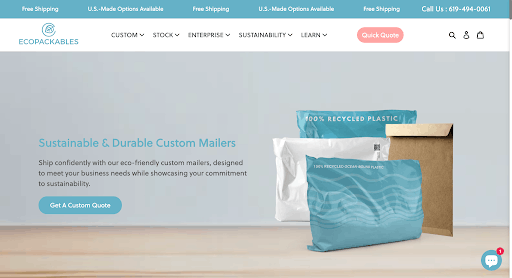
EcoPackables is a San Diego-based sustainable packaging company working exclusively with ecommerce brands. Their product range covers custom mailers, padded mailers, poly bags, boxes, and void fill — all built from recyclable, compostable, or recycled-content materials, including proprietary materials like BioLaminate™ and Renewa™, backed by third-party life cycle assessments.
What distinguishes EcoPackables from general packaging suppliers is active sustainability compliance management and packaging label auditing as part of their service. For managers who need their packaging claims to be defensible under FTC Green Guides or the EU PPWR, having a Certified B Corporation with Yale Center for Business and Environment recognition handling that compliance burden is a meaningful operational advantage. They serve over 10,000 brands across North America, with major retail partners including Ted Baker, Revolve, and L.L. Bean. Production lead times start at 25 business days.
Best for: Organisations prioritising certified sustainability credentials and compliance support.
2. Mid-Atlantic Packaging — Best for boutiques and specialty retailers
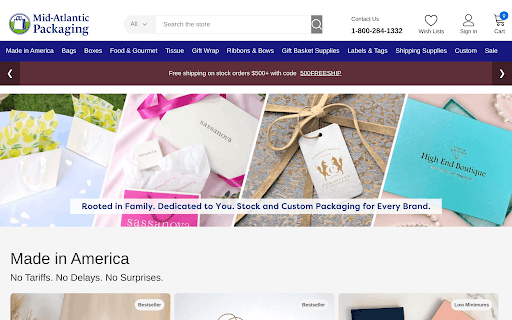
Mid-Atlantic Packaging is a family-owned wholesale supplier based in Dover, Delaware, with over 40 years in the industry. Their range covers bags, boxes, food packaging, tissue paper, gift wrap, and custom-printed items, with a focus on American manufacturing and daily UPS shipping. Their kraft paper options suit brands that want a natural packaging aesthetic without committing to the higher cost or longer lead times of fully certified sustainable packaging.
For smaller retail operations where predictable supply and competitive per-unit cost at boutique order volumes matter more than third-party certification, Mid-Atlantic Packaging addresses the practicalities well. Their four decades of supply chain reliability provides the consistency that newer eco-focused companies are still building toward.
Best for: Small and medium retailers prioritising pricing, variety, and supply reliability.
3. Packwire — Best for custom packaging with fast turnaround
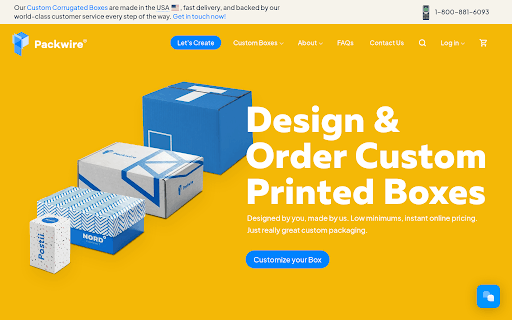
Packwire specialises in custom corrugated boxes and branded mailers manufactured in the USA, with delivery times of 10 to 20 days. Built on over 70 years of packaging experience, they offer folding cartons, shipping boxes, and gift boxes with minimum orders starting at 10 units. Their use of UV-curable inks and precision laser systems eliminates traditional tooling fees, allowing brands to change design between orders without additional setup costs — a genuine advantage for seasonal campaigns or rebrands.
Their North American manufacturing model also keeps carbon emissions per unit lower than offshore production alternatives, which matters when building a credible environmental case for packaging choices in sustainability reporting.
Best for: Brands needing custom packaging flexibility without high minimum orders or setup fees.
4. Packlane — Best for flexible order quantities
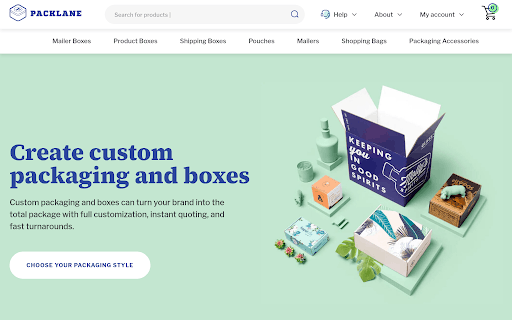
Packlane is an online platform for custom packaging design and printing, based in Sherman Oaks, California. Their product range covers mailer boxes, shipping boxes, product boxes, and specialty packaging with a 3D design tool that allows brands to see exactly how packaging will look before ordering. The minimum order quantity of one box is industry-leading — most competitors require 25 to 50 units — making it genuinely viable to sample or photograph custom packaging before committing to volume.
Standard turnaround runs 7 to 10 business days. Packlane’s track record includes over 10,000 brands with clients including Google and Shopify, indicating capacity to handle both small creative runs and bulk production.
Best for: Growing brands that want to invest in custom sustainable packaging without minimum order risk.
5. BoxUp — Best for small to mid-sized brands and subscription businesses
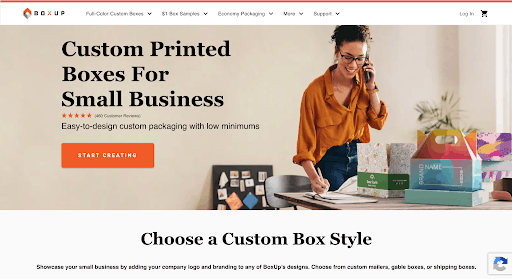
BoxUp is a corrugated packaging company based in Terre Haute, Indiana, built to make custom printed boxes accessible for smaller businesses. They use digital printing technology and a proprietary online design platform with no minimums, unlimited colour options at a flat price, and an approval-to-print turnaround of around 10 business days. The combination of no setup costs and no minimum order removes the financial barriers that typically keep smaller ecommerce brands stuck with generic packaging.
BoxUp holds a 4.7 rating across over 6,000 customer reviews — a meaningful signal of consistent execution at scale. Small business owners and subscription box operators consistently cite the DIY design platform and print quality as reasons for returning.
Best for: Small ecommerce brands and subscription businesses that need custom packaging without upfront cost commitment.
How to Choose the Right Supplier for Your Operation
The right sustainable mailer supplier depends on matching your specific requirements against what each company actually delivers rather than what their homepage claims. A structured evaluation framework helps managers avoid the most common procurement mistakes in this category.
The questions that matter
Start with certifications. Does the supplier hold How2Recycle, BPI Certified, FSC, or equivalent third-party verification? Are those certifications current and verifiable — not just mentioned on the website but checkable against the certifying body’s records? A supplier that claims certifications they can’t evidence creates compliance risk rather than reducing it.
Then consider operational fit. What is the actual lead time from order to delivery, and does that work within your fulfilment model? What are the minimum order quantities at your realistic order frequency, and what does the per-unit cost look like at that volume? Can they accommodate custom branding without inflated setup costs? Are they set up to provide the recycled content percentage, carbon emissions data, or composting timeline information that your sustainability reporting requires?
Finally, consider geographic alignment. A supplier producing in North America has different carbon implications per unit than one manufacturing offshore. Depending on where your customers are and what regulatory framework applies to your business, that may or may not be material to the decision. The Knowledge Hub on managing projects and change covers procurement evaluation frameworks that apply directly here — particularly around defining requirements before comparing options, rather than comparing options and hoping requirements emerge.
The Management Dimension
Packaging procurement decisions connect to something larger than logistics. The sustainable mailer that arrives on a customer’s doorstep is, in a small but visible way, a signal about whether your organisation’s environmental commitments are real or rhetorical. Research consistently confirms that customers are increasingly checking. In nearly 80% of product categories, more types of ESG claims correlated with faster sales growth in the McKinsey/NielsenIQ study — but the same research found that specificity and verification matter. Vague environmental claims are less commercially effective than specific, substantiated ones, and they carry higher regulatory risk.
For managers responsible for procurement, this means that packaging supplier selection is now part of the same discipline as any other ESG supply chain decision — and deserves the same analytical rigour. Getting the certifications right, choosing a supplier who can evidence their claims, and being able to report accurately on recycled content and composting timelines are operational requirements, not marketing niceties. They are also, increasingly, what buyers, investors, and regulators are looking for. Good decision making and goal setting practice treats this as a strategic priority rather than a purchasing detail.
Further Reading
- EcoPackables: Sustainable Packaging Statistics 2026 — The most comprehensive current data roundup on sustainable packaging market size, consumer behaviour, regulatory developments, and the commercial case for ESG-backed packaging claims. Read the article
- EcoVadis: Sustainable Procurement Barometer 2026 — Annual research from EcoVadis covering how leading organisations are embedding ESG intelligence into procurement decisions, including supplier visibility, carbon data requirements, and the shift from compliance to competitive advantage. Read the report
- EU Packaging and Packaging Waste Regulation (PPWR) — Official Text — The primary source for the EU regulatory framework applying from August 2026, including recyclability mandates, void space restrictions, and minimum recycled content targets. Essential reference for any organisation selling into EU markets. Read the regulation
Header image by Pixabay
Disclaimer
The content on this site is provided for general information and educational purposes only. It reflects the author’s views and experience and is not intended as professional legal, compliance, or procurement advice. Packaging regulations vary by jurisdiction and are subject to change. Readers should verify current certification standards and regulatory requirements with appropriate professional advisers before making procurement decisions. The Happy Manager and Apex Leadership Ltd accept no liability for actions taken in reliance on the content of this article.
References
- McKinsey & Company / NielsenIQ (2023). Consumers Care About Sustainability — and Back It Up With Their Wallets. Referenced in: EcoPackables (2026). https://www.ecopackables.com/blogs/news/sustainable-packaging-statistics
- EcoVadis (2026). Sustainable Procurement Barometer 2026. https://ecovadis.com/insights/barometer/
- European Parliament (2025). Regulation (EU) 2025/40 — Packaging and Packaging Waste Regulation (PPWR). https://eur-lex.europa.eu/legal-content/EN/TXT/?uri=OJ:L_202500040
- Mordor Intelligence (2026). Sustainable E-Commerce Packaging Market Size, Growth and Outlook 2026–2031. https://www.mordorintelligence.com/industry-reports/sustainable-e-commerce-packaging-market
- EcoVadis (2026). ESG Investing Trends Shaping Procurement in 2026. (FCA anti-greenwashing rule and ESMA ESG disclosure requirements.) https://ecovadis.com/blog/esg-investing-trends/
Leadership Resources
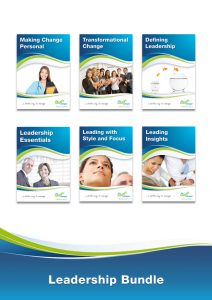 For more leadership resources look at our great-value guides. These include some excellent tools to help your personal development plan. The best-value approach is to buy our Leadership bundle, available from the store.
We’ve bundled together these five e-guides at half the normal price! Read the guides in this order, and use the tools in each, and you’ll be well on your way to achieving your personal development plan. (6 guides, 167 pages, 27 tools and 22 insights, for half price!)
- Leadership Essentials
- Defining Leadership
- Leading Insights
- Leading with Style and Focus
- Transformational Change
- Making Change Personal
Blog Content: Most blog pages on this site are from sponsored or guest contributors. Although we may receive payment for these, all posts are vetted to ensure they meet our editorial standards and offer value for our readers.
>> Return to the Leadership Knowledge Hub