In-Home Product Testing Platforms: A Consumer Research Guide for CPG Managers
27 August 2026
In-Home Product Testing Platforms: A Consumer Research Guide for CPG Managers
Note for Non-US and Non-Canadian Readers
The five platforms featured in this article are headquartered and operate primarily in North America, and this guide is aimed chiefly at managers and brand teams working in that market. For UK and international readers, the underlying management principles — structured vendor evaluation, validation methodology, and building consumer research into the development process — apply directly to your own platform selection process regardless of geography; the specific platforms will differ.
Why In-Home Product Testing Deserves Management Attention
This paid partnership guide covers in-home product testing platforms as a management decision for CPG brands. Most CPG brands don’t fail at product development because of bad formulas. They fail because they never get honest feedback from real people using the product at home. In-home product testing platforms exist to close that gap, but the challenge is real: recruiting a diverse, representative tester panel is hard, keeping participants engaged throughout a study is harder, and managing physical product logistics at scale can quietly sink the whole programme.
Choosing the right platform isn’t just a vendor decision — it directly shapes the quality of the data feeding into every product development conversation that follows. The challenge most brands run into isn’t finding testers; it’s finding the right testers, people who genuinely match the target consumer profile, and keeping them engaged long enough to generate meaningful feedback. When participant diversity is off or completion rates drop mid-study, purchase intent scores get skewed, qualitative feedback becomes shallow, and the resulting data loses its reliability — which makes platform selection a management decision with consequences well beyond the procurement line item. The five platforms below were selected and verified by our partner using publicly available information from official product pages, client case studies, and user reviews across research directories. Good decision making and problem solving practice treats platform selection in this category as a genuine management priority rather than a default carried forward from whichever vendor made first contact.
Five In-Home Product Testing Platforms Worth Considering
- Peekage — Best for in-home product testing and consumer insights research
- Zappi — Best for enterprise brand research and advertising optimisation
- Suzy — Best for enterprise consumer insights and market research
- Qualtrics — Best for enterprise market research and experience management
- Quantilope — Best for enterprise consumer insights automation and rapid quantitative market research
Quick Comparison
- Peekage — Established: 2019 | Team size: 18 | Headquartered: Toronto, Canada
- Zappi — Established: 2013 | Team size: 300 | Headquartered: Boston, United States
- Suzy — Established: 2009 | Team size: 186 | Headquartered: New York, United States
- Qualtrics — Established: 2002 | Team size: 6,018 | Headquartered: Provo, Utah
- Quantilope — Established: 2014 | Team size: 198 | Headquartered: Hamburg and New York
Peekage — Best for in-home product testing and consumer insights research
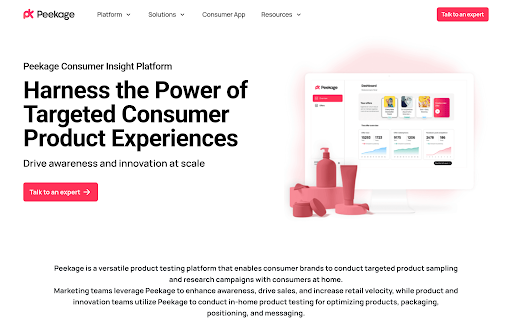
Peekage operates as an all-in-one platform built for consumer brands that need to test physical products in real home environments, covering three connected areas: digital product sampling, in-home product testing, and consumer insights research. With access to more than five million shoppers and a study generation layer, the platform makes enterprise-grade research accessible to brands without in-house data scientists — faster time-to-insight without sacrificing the depth that product and R&D teams need. Peekage solves the problem of running rigorous in-home testing without the cost or overhead of a traditional research firm; client results such as KIND’s reported 6x ROI and Wise Snack’s 70% cost savings reflect a platform that hasn’t cut corners on methodology to get there. Brands using the service consistently point to the speed of setup and the quality of participant targeting as standout strengths, with the unified sampling-and-insights platform frequently cited as removing friction that’s common where most tools handle only one piece of the research process.
Best for: Brands that want an end-to-end in-home testing and consumer insights solution without the overhead of a traditional research firm.
Zappi — Best for enterprise brand research and advertising optimisation
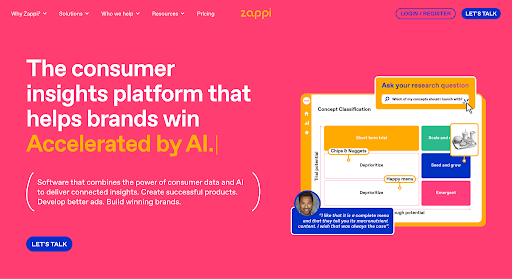
Zappi is organised around three systems — the Innovation System for consumer testing, the Research System for ad effectiveness, and the Brand Health System for ongoing brand tracking — with speed as the standout feature: consumer insights delivered in six to eight hours rather than the weeks traditional research typically requires. Serving more than 350 global brands, including PepsiCo and McDonald’s, Zappi has built a track record across major enterprise accounts; this is firmly an enterprise-scale tool rather than a small-team option. The platform addresses the lag problem in consumer research by keeping consumers in the loop continuously rather than treating feedback as a one-time event, which matters because product decisions rarely wait for slow research cycles to complete. PepsiCo’s reported 30% improvement in creative effectiveness is a concrete indicator of performance at scale, and enterprise teams consistently value the speed and AI-backed analysis most — reinforced by back-to-back MarTech Breakthrough Awards.
Best for: Enterprise brand research and advertising optimisation, particularly where speed of turnaround matters.
Suzy — Best for enterprise consumer insights and market research
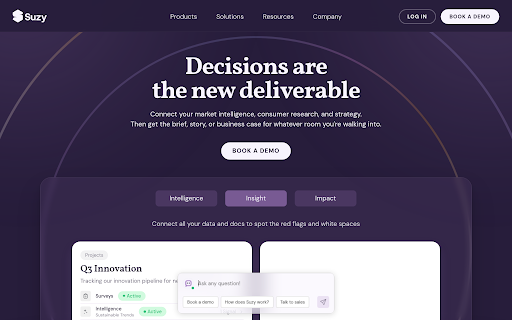
Suzy positions itself as a decision engine rather than a simple survey tool, combining quantitative data, qualitative feedback, and audience insight inside a single research cloud, backed by a proprietary panel of more than one million verified consumers. Survey design, automated templates, analysis, and reporting all live in one place, removing the handoffs between separate tools that slow most research programmes down — enterprise teams at Walmart, Estée Lauder, and Mondelēz all use the platform, which gives a sense of the volume and complexity it’s built to handle. Users consistently point to the proprietary consumer panel and speed of insight delivery as the two things that separate Suzy from competing platforms, and teams working across marketing, product, and insights functions find the multi-use-case design genuinely practical rather than a feature list for its own sake.
Best for: Enterprise teams running consumer insights and market research across multiple functions from one connected system.
Qualtrics — Best for enterprise market research and experience management
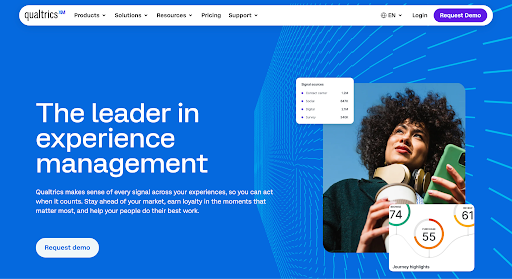
Qualtrics is an experience management platform that collects and connects feedback across surveys, calls, digital interactions, and service touchpoints inside one system, covering omnichannel feedback collection, sentiment analysis, and automated workflows powered by what the company calls Experience Agents. The platform also includes research-grade synthetic audiences built on large language models, letting teams validate hypotheses before committing to full-scale studies. With a team of more than 6,000 people and backing from investors including Silver Lake, Qualtrics has the infrastructure to support large, simultaneous global research programmes. Case studies such as Gabb cutting research costs by 50% against traditional methods reflect what users report: real time and budget savings at scale. Enterprise clients value the breadth of the toolset, though teams with narrower research needs sometimes find the full platform larger than what they actually require.
Best for: Large enterprise operations that need experience management and market research unified across every feedback channel.
Quantilope — Best for enterprise consumer insights automation and rapid quantitative market research
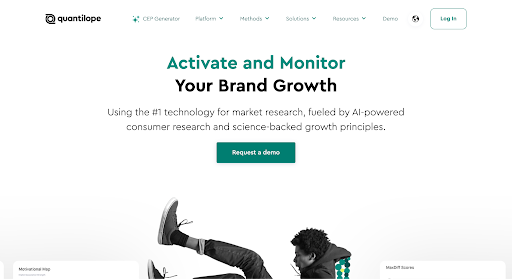
Quantilope automates advanced research methods that would normally require specialist analysts to run — 16 automated methods in total, including MaxDiff, TURF, and Implicit Testing — supported by an integrated AI co-pilot called Quinn that guides users through study design and analysis. Access to a panel of more than 300 million consumers worldwide removes participant recruitment as a bottleneck, and insights become accessible in under one second after responses come in, reflecting genuine engineering investment in research speed. Nestlé, Pepsi, and Danone are among more than 300 brand clients, giving a sense of the scale Quantilope operates at. The platform removes the specialist dependency that typically slows advanced quantitative research, making methods such as MaxDiff and TURF accessible to insights teams without a data science background. Samsung’s reported 80% cost reduction per tested ad and 48-hour turnaround times are concrete proof points, and consistent recognition as the top market research technology in Greenbook’s GRIT Report — two years running — tracks with client feedback about reliability and methodological depth.
Best for: Teams that want advanced quantitative methods automated and delivered fast, without a specialist analyst on staff.
How These Platforms Were Chosen and Verified
Data Collection Foundations
The research started by building a broad initial list of platforms operating in the in-home product testing and consumer insights space. Sources included research platform directories, professional review sites, publicly available case study libraries, and the official websites of companies known to serve CPG, FMCG, and consumer goods brands. The goal at this stage was breadth — pulling in enough options to ensure that strong performers weren’t overlooked before the narrowing process began.
The Shortlisting Pass
Once the initial list was assembled, options with thin or unverifiable track records were removed. This pass focused on review pattern analysis — looking at whether feedback was consistent across multiple independent sources or concentrated in ways that suggested limited real-world use. Platforms that appeared frequently in the research but lacked documented results with named clients didn’t move forward. The shortlist that emerged reflected platforms with genuine market presence in consumer research.
Verification Pass
Each shortlisted platform went through a cross-checking process where claims made on official websites were compared against what actual users reported. Where a company described specific capabilities, the verification step looked for client examples or case study evidence that those capabilities performed as described. Platforms where the gap between stated features and documented outcomes was significant were flagged or removed from consideration.
Industry Recognition and Authority
Recognition from established industry bodies was factored in as a signal of credibility. This included awards from organisations tracking market research and consumer insights technology, mentions in analyst reports covering the insights software space, and evidence of platforms contributing original thinking to the field. Recognition alone wasn’t a deciding factor, but it helped confirm that a platform had standing within the professional research community rather than just marketing visibility.
Evidence Specific to In-Home Product Testing
The final evaluation layer focused on whether each platform had demonstrated capability in the in-home product testing context specifically — dedicated service pages covering product sampling and home-use testing, client reviews referencing in-home or physical product testing scenarios, and case studies where consumer goods brands used the platform for pre-launch product evaluation. Platforms with generic research capabilities but no evidence of work in this specific area were excluded from consideration.
What to Look for When Choosing an In-Home Product Testing Platform
Picking the right platform comes down to more than a feature list. The practical question is whether it can handle your specific research context — from participant sourcing through to final reporting — without creating operational gaps you have to fill manually.
Domain experience matters more than a platform’s marketing suggests. A vendor with a documented history in consumer goods research — CPG, food and beverage, or personal care categories specifically — brings fewer surprises to study design than a generalist research tool. Fragmented toolsets create their own cost: the best platforms cover participant recruitment, product logistics support, study design, and reporting in one place, removing the handoffs that slow research programmes down elsewhere. Pricing structures vary widely by panel size, study complexity, and turnaround time, and the practical question — per-study or subscription — is worth settling before commitment, since enterprise pricing can escalate quickly once volume grows. Results measurement should track the metrics that actually inform decisions: panelist completion rate, purchase intent lift, and the depth of qualitative feedback, not simply survey completion counts. For regulated product categories, verify a platform’s familiarity with the relevant compliance frameworks — FDA guidance and ISO 20252 standards among them — before running studies on sensitive product types.
The in-home product testing space has matured considerably, and the platforms above reflect that. Peekage suits brands wanting an end-to-end solution without the overhead of a traditional research firm; Zappi and Quantilope suit teams that need speed and methodological depth; Suzy and Qualtrics fit larger enterprise operations running research across multiple functions. The right choice depends on team size, product category, and how much of the research process a business wants to own outright — but the underlying management principle holds regardless of platform: validated consumer feedback, gathered before a launch decision rather than after it, is one of the highest-return disciplines available to anyone responsible for bringing new products to market.
Further Reading
- Faunalytics: How to Choose a Market Research Vendor — Practical evaluation criteria for assessing research vendors and proposals, including reputation, methodological expertise, and how to compare competing bids on a like-for-like basis. Read the guide
- Customcy: New Product Development Statistics 2026 — A well-sourced collection of current data on launch success and failure rates and the research practices most strongly associated with commercial success. Read the article
- TGM Research: Why Product Launches Fail — A Consumer Insights Guide — A detailed analysis of the most common causes of product launch failure, including confirmation bias and the specific gaps in consumer understanding that lead to products that don’t resonate. Read the guide
Header image by: Mohamed_hassan
Disclosure and Disclaimer
Our blog posts are paid partnerships, unless stated otherwise. See our disclosure policy for details. The five platforms featured, and the vetting and verification process described in this article, were selected and provided by our paid partner — their inclusion reflects that process, not an independent evaluation, recommendation, or endorsement by The Happy Manager. The management context, and the broader relevance of the evaluation criteria to platform selection generally, are our own editorial framing. The platforms featured are primarily headquartered and operate in North America — readers in other jurisdictions should seek equivalent services in their own region.
The content on this site is provided for general information and educational purposes only. It reflects the author’s views and experience and is not intended as professional market research, product development, or procurement advice. Platform capabilities, pricing, and client results change frequently — readers should verify current specifications directly with vendors before making commissioning decisions. The Happy Manager and Apex Leadership Ltd accept no liability for actions taken in reliance on the content of this article.
References
- Faunalytics (2022). How to Choose a Market Research Vendor. (Vendor evaluation criteria: reputation, methodological expertise, proposal comparison.) https://faunalytics.org/choose-market-research-vendor/
- Customcy (2026). New Product Development Statistics 2026. (30,000 new products launched annually; 95% fail; 30% of NPD projects become commercial successes.) https://customcy.com/blog/new-product-development-statistics/
- TGM Research (2025). Why Product Launches Fail: A Consumer Insights Guide. (Confirmation bias and consumer-understanding gaps in failed product launches.) https://tgmresearch.com/consumer-insights-guide/why-product-launches-fail.html
Leadership Resources
 For more leadership resources look at our great-value guides. These include some excellent tools to help your personal development plan. The best-value approach is to buy our Leadership bundle, available from the store.
We’ve bundled together these five e-guides at half the normal price! Read the guides in this order, and use the tools in each, and you’ll be well on your way to achieving your personal development plan. (6 guides, 167 pages, 27 tools and 22 insights, for half price!)
- Leadership Essentials
- Defining Leadership
- Leading Insights
- Leading with Style and Focus
- Transformational Change
- Making Change Personal