AI Saves Drafting Time. Managers Still Have to Own the Rework
26 November 2026
A faster draft feels like a productivity breakthrough. A customer email that once took twenty minutes now takes five. A manager sees fewer hours on the weekly report and assumes the work itself has become easier. But the unanswered questions have merely moved downstream. Who checks whether the answer is right? Who resolves the customer’s unusual circumstances? Who notices if the same mistake turns up next week? This guest post from Dr. Gleb Tsipursky provides some interesting insights.
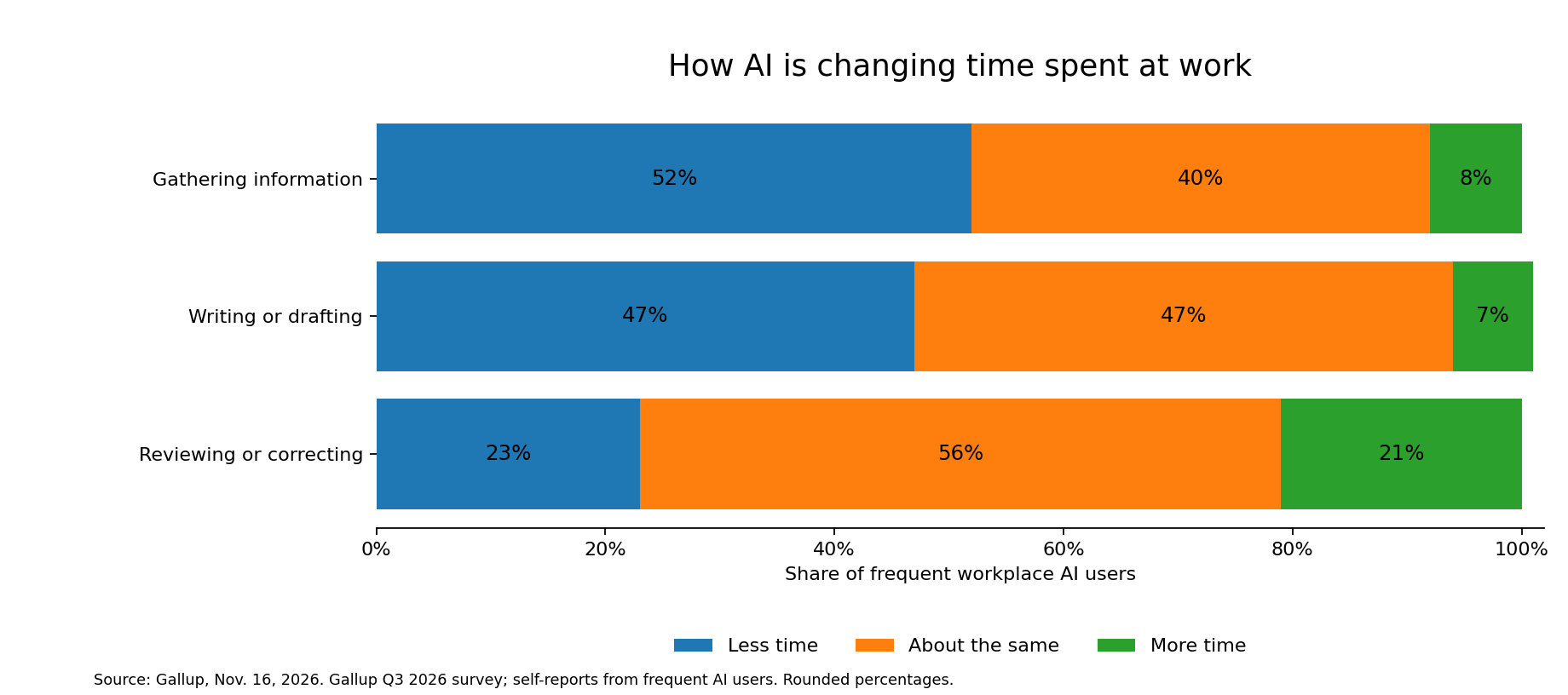
The distinction matters because a new Gallup study gives managers a more realistic view of the AI workday. In research published November 16, 2026, 52% of frequent workplace AI users reported spending less time gathering information, and 47% reported spending less time writing or drafting since they began using AI. Yet 21% spent more time reviewing and correcting work. Among frequent users, 82% said their time working with customers or clients stayed about the same. These are employee self-reports, not measured productivity gains. They nevertheless highlight a management challenge: automation can change the mix of work without shrinking the whole job.
The real question is whether managers redesign accountability as quickly as software changes the first draft.
Follow the Work After the Draft
Imagine a small insurance team preparing customer explanations. An AI assistant drafts a letter using a policy summary. The draft arrives quickly, and the team celebrates. Then an employee discovers that the customer’s situation falls under a policy exception. Someone must locate the original documents, check the rule, revise the wording, and explain the decision. The team saved minutes on the opening draft but spent more time handling an exception. This is a hypothetical example, but the same pattern can appear in sales, human resources, procurement, and customer support.
Managers commonly count the time an AI tool saves at the start of a process. They overlook the work that follows: verification, correction, approval, clarification, and recovery from mistakes. A seemingly impressive demonstration can fail to improve an end-to-end process because nobody measured those steps before introducing the tool.
Start with a simple baseline. For ten ordinary tasks, record how long an employee spends researching, drafting, reviewing, approving, and correcting mistakes. Repeat the measurement after introducing AI. Include the time spent asking a colleague to clarify an answer, the delays caused by exceptions, and the hours required to rework a finished product. The sample is deliberately small enough for a manager to run without hiring a consultant or building a dashboard. Its purpose is to reveal where effort moved.
A manager might discover that AI cuts drafting from twelve minutes to four while review rises from two minutes to seven. That produces a net gain of three minutes on straightforward cases, rather than the eight-minute benefit suggested by draft time alone. On complicated cases, the result could be worse. These figures illustrate the calculation; they are not measured findings. Recording the real numbers prevents a good-looking pilot from becoming an expensive permanent routine.
Give Every Exception a Human Owner
Many teams already know who approves routine work. Fewer have named the person who takes over when an AI result conflicts with source material or a customer needs an answer outside the normal script. That ambiguity creates a quiet management cost: employees either wait for permission, invent a workaround, or pass the error to somebody else.
Before putting an AI-supported workflow into production, identify the employee who can pause it, resolve disputed cases, and authorize corrections. Give that person a backup. State which decisions require human review and what evidence the reviewer must check. In a claims team, that could be the governing policy wording. In recruiting, it could be the actual job requirements and documented interview notes. In purchasing, it could be the signed contract and the supplier’s confirmation.
The National Institute of Standards and Technology’s voluntary AI Risk Management Framework organizes responsible management around four functions: govern, map, measure, and manage. Those concepts become useful when translated into everyday roles. Governing means assigning a decision owner. Mapping means identifying the places mistakes matter most. Measuring means testing results and tracking incidents. Managing means fixing problems and adjusting the workflow. A manager can apply this sequence to a single team without turning it into a large technical project.
Protect the Learning That Produces Good Judgment
A second problem is less visible. The employee who used to research an answer from scratch learned why a case was unusual. The junior analyst who assembled a messy report learned which numbers never reconcile cleanly. AI can remove some of that repetitive effort, which is valuable, while also removing practice that helps people recognize errors later.
Managers should ask what judgment employees are building when AI performs more of the routine steps. If the answer is unclear, change the training design. Let newer employees compare AI suggestions against original documents, explain why an answer is incomplete, and write down the exception they found. Pair them with an experienced reviewer who explains the reason for a correction rather than silently fixing the result.
This does not require a ban on AI or a return to inefficient manual work. It requires making the learning step visible. One hour of structured review may prevent a team from producing a generation of workers who can approve polished-looking output but cannot tell when its reasoning has gone wrong.
Measure Quality, Trust, and Recovery
Time saved belongs on a manager’s scorecard, but it cannot stand alone. Four additional measures make it harder for a weak process to hide behind speed. Track the percentage of outputs accepted without material corrections. Count the number of cases that require escalation. Measure the average time to resolve those exceptions. Ask employees whether they know when to trust, challenge, or stop the system. Managers should compare these figures across equivalent task types, rather than pooling easy and complex cases into a misleading average.
Use a weekly team conversation to examine one successful case and one failure. What did the employee notice? Which instruction or document was missing? Did the right person have authority to act? What change would make the process safer and faster next time? Keep the discussion focused on improving the workflow. Employees who expect punishment for admitting a faulty AI result have a reason to conceal the problem, leaving managers with artificially reassuring data.
Gallup’s November 16 findings also caution against assuming that faster work automatically raises expectations. Only 29% of employees in organizations adopting AI agreed that the technology had raised the amount of work expected each day. Managers should make choices about workload explicitly instead of letting employees guess. Time saved might support better service, more careful decisions, employee development, or reduced backlog. Each is a different objective, requiring a different measure.
Turn the Next AI Pilot Into a Management Test
For the next thirty days, choose one recurring activity. Measure its full process before making changes. Assign an exception owner and specify what requires review. Introduce AI in a limited group. Compare the time spent drafting, reviewing, and recovering from errors, alongside quality and customer outcomes. Ask employees what they learned, where they hesitated, and which safeguards helped them work confidently. Expand only when the evidence shows an improvement that survives real cases.
The manager’s most important contribution is not choosing which AI button staff should click. It is deciding who remains accountable, what gets measured, and how people improve their judgment as the work changes. Fast drafts are useful. A reliable team that knows how to finish the job is the real productivity gain.
Author Bio: Gleb Tsipursky, PhD, is a behavioral scientist, CEO of Disaster Avoidance Experts, and author of The Psychology of AI Adoption at Work: From Resistance to Results (Georgetown University Press, 2026).
Disclosure and Disclaimer
This is an independently written guest post, not a partnered post. See our disclosure policy for details. The views, examples and calculations are the author’s own. The author’s biography links to his book, which is included for attribution and is not an endorsement by The Happy Manager. The article is provided for general information and educational purposes only and is not professional advice. The Gallup figures it cites are employee self-reports from a United States survey, so results may differ in other countries and workforces. Any hypothetical examples and calculations are illustrations, not measured findings. Employment, data protection and AI regulation differ by country and change often. UK readers should check current guidance on gov.uk and from the Information Commissioner’s Office. US readers should check requirements with the relevant federal and state authorities. Readers in Australia should check guidance from the National AI Centre and the Office of the Australian Information Commissioner. Organisations introducing AI tools should take advice appropriate to their sector and jurisdiction. We make reasonable efforts to ensure that the information and links in this article were accurate at the time of publication. External websites, regulations and data change over time, so we cannot guarantee that they remain accurate or available. The Happy Manager and Apex Leadership Ltd accept no liability for actions taken in reliance on the content of this article.
Further Reading
- AI Risk Management Framework Playbook — NIST (US): Voluntary suggested actions for the govern, map, measure and manage functions. Read the playbook
- AI Management Essentials — Department for Science, Innovation and Technology (UK): A self-assessment tool to help organisations establish AI management practices. Visit the tool
- Guidance for AI Adoption — Department of Industry, Science and Resources (Australia): Six essential practices for responsible AI governance, including deciding who is accountable and maintaining human control. Read the guidance
- AI Use at Work: Organizational Adoption Jumps — Gallup (US): Gallup’s earlier Q2 2026 data on how employees use AI at work. Read the report
- Beyond Productivity: Measuring the Real Value of AI — Workday (global): Vendor research on how much AI time saving is lost to rework; read it as indicative, not independent. Read the release
References
- Gallup (2026), How AI Is Changing the Way Employees Spend Time at Work (52% of frequent users spend less time gathering information; 47% less time writing or drafting; 21% more time reviewing and correcting; 82% same time with customers; 29% in AI-adopting organisations say expectations rose). https://www.gallup.com/workplace/716585/ai-changing-employees-spend-time-work.aspx
- NIST (2023), Artificial Intelligence Risk Management Framework (AI RMF 1.0) (four core functions: govern, map, measure, manage). https://airc.nist.gov/airmf-resources/airmf/
- Tsipursky, G. (2026), The Psychology of AI Adoption at Work: From Resistance to Results, Georgetown University Press (author’s book, cited in the biography). https://disasteravoidanceexperts.com/aibook
Image by Mohamed Hassan from Pixabay
Leadership Resources
 For more leadership resources look at our great-value guides. These include some excellent tools to help your personal development plan. The best-value approach is to buy our Leadership bundle, available from the store.
We’ve bundled together these five e-guides at half the normal price! Read the guides in this order, and use the tools in each, and you’ll be well on your way to achieving your personal development plan. (6 guides, 167 pages, 27 tools and 22 insights, for half price!)
- Leadership Essentials
- Defining Leadership
- Leading Insights
- Leading with Style and Focus
- Transformational Change
- Making Change Personal