What Every CFO Needs to Future-Proof Their Team
12 July 2025
What Every CFO Needs to Future-Proof Their Team
Finance isn’t just about the numbers anymore. Today’s Chief Financial Officers sit at the intersection of innovation, resilience, and strategic influence. From managing economic uncertainty to driving digital transformation, CFOs play a pivotal role in shaping the future of high-performing organizations.
In a fast-moving environment, automation is no longer a luxury—it’s a strategic imperative. This post explores how finance leaders can empower their teams through smart technology, build resilient functions, and lead with clarity in the face of disruption. Let’s dive into the transformative power of finance automation.
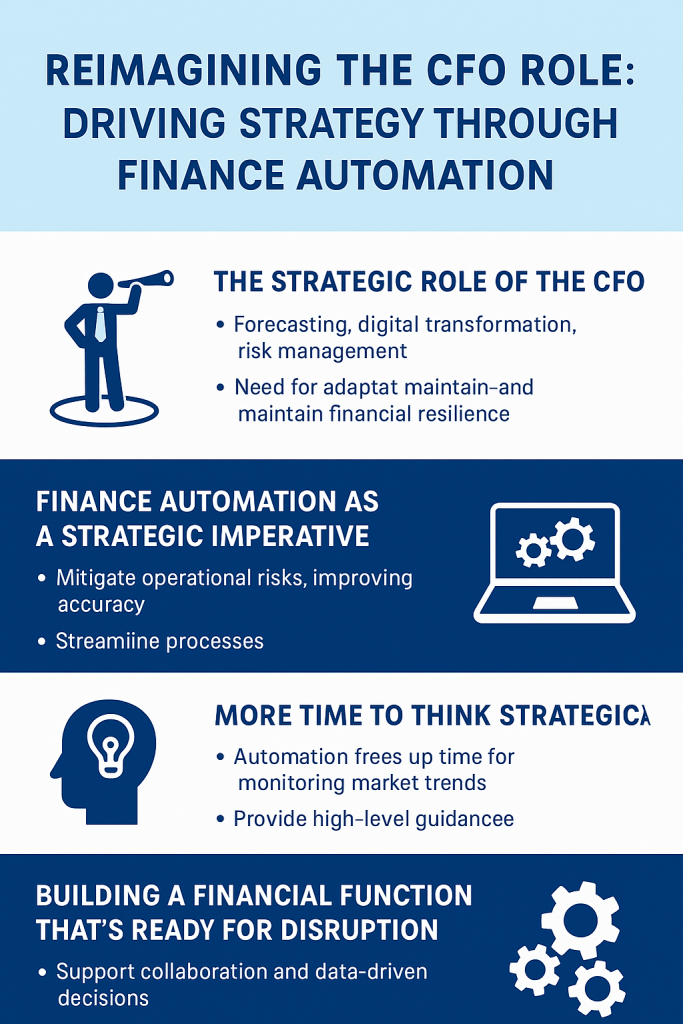
The Strategic Role of the CFO in an Evolving Financial Landscape
Chief Financial Officers today manage a wide spectrum of responsibilities—from forecasting and financial reporting to digital transformation and risk management. In an increasingly complex environment, businesses must not only adapt but excel at data analysis to maintain a competitive edge. These functions mirror the dynamic nature of modern markets.
Success in such volatile conditions requires organizations to craft smart growth strategies, respond swiftly to emerging challenges, and uphold financial resilience.
Finance Automation as a Strategic Imperative
In this context, investing in finance automation has become a crucial move to safeguard business finances. Through automation, CFOs can drive greater accuracy, minimize operational risk, and shift focus toward higher-value strategic goals.
Functions such as payroll, billing, budgeting, and financial reporting all benefit from streamlined processes. By significantly reducing manual tasks—often prone to errors and delays—automation empowers finance teams to work more efficiently and prepare proactively for the future.
More Time to Think Strategically
Traditionally, finance professionals devoted large portions of their schedules to data entry, account reconciliation, and closing books. With automated systems, these repetitive tasks can be completed faster and with more precision.
This evolution allows teams more time to monitor market trends, assess financial risks and opportunities, and offer timely, strategic insights. The most effective finance departments distinguish themselves by delivering agile, high-level guidance when it matters most.
Equipping Teams with Digital Fluency
To realise the full benefits of automation, CFOs must ensure their teams are digitally competent. Modern financial operations demand an understanding of how data moves through systems, automation platforms, and analytics dashboards.
It’s no longer enough to be numerically adept—finance professionals must continuously update their skills, stay receptive to change, and collaborate across functions such as IT and operations. Enhanced technological fluency not only strengthens internal processes but also contributes to broader organizational innovation.
Safeguarding Data Integrity and Managing Risk
Automation hinges on one fundamental factor: data accuracy. CFOs must lead with a clear focus on data integrity, developing robust controls to secure financial data with precision.
Implementing audit trails, validation rules, and real-time alerts reinforces fraud prevention and regulatory compliance. With thoughtful governance, automation becomes a tool not only for efficiency, but also for building transparency and trust across financial operations.
Building a Financial Function That’s Ready for Disruption
Looking ahead, resilience should take precedence over pure efficiency. CFOs must cultivate teams capable of responding confidently to disruption, navigating change, and solving complex problems under pressure.
Finance automation plays a key role—fostering collaboration, supporting data-driven decision-making, and enabling agile responses to uncertainty. Forward-looking finance leaders use technology to complement human expertise, not override it. By emphasizing adaptability and strategic thinking, they cultivate a proactive culture that thrives even in ambiguous situations.
Ready to Future-Proof Your Finance Team?
If you’re looking to lead with confidence in today’s shifting landscape, now is the time to invest in your strategy, skills, and systems. Whether you’re a CFO, a financial strategist, or a leadership coach—build the foundation for sustainable success.
Explore further with these recommended reads:
- Strategic Leadership: Think Smart, Act Smart
- Digital Transformation in Finance: A Practical Guide
- Finance Function of the Future: From Automation to Intelligence
Building better teams
 If you want more resources for team building strategies, you’ll find more information and a wealth of practical resources, in our colossal Team Building Bundle.
Containing 240 pages and 50 tools, these are the 8 key guides we recommend to help you do more than define teamwork, build it!
Why is Teamwork Important
Build a Better Team
The Problems with Teams
Team Health Check
Team Building Exercises
Leading with Style and Focus
What’s the Problem?
Making Better Decisions
Blog Content: Most blog pages on this site are from sponsored or guest contributors. Although we may receive payment for these, all posts are vetted to ensure they meet our editorial standards and offer value for our readers.